
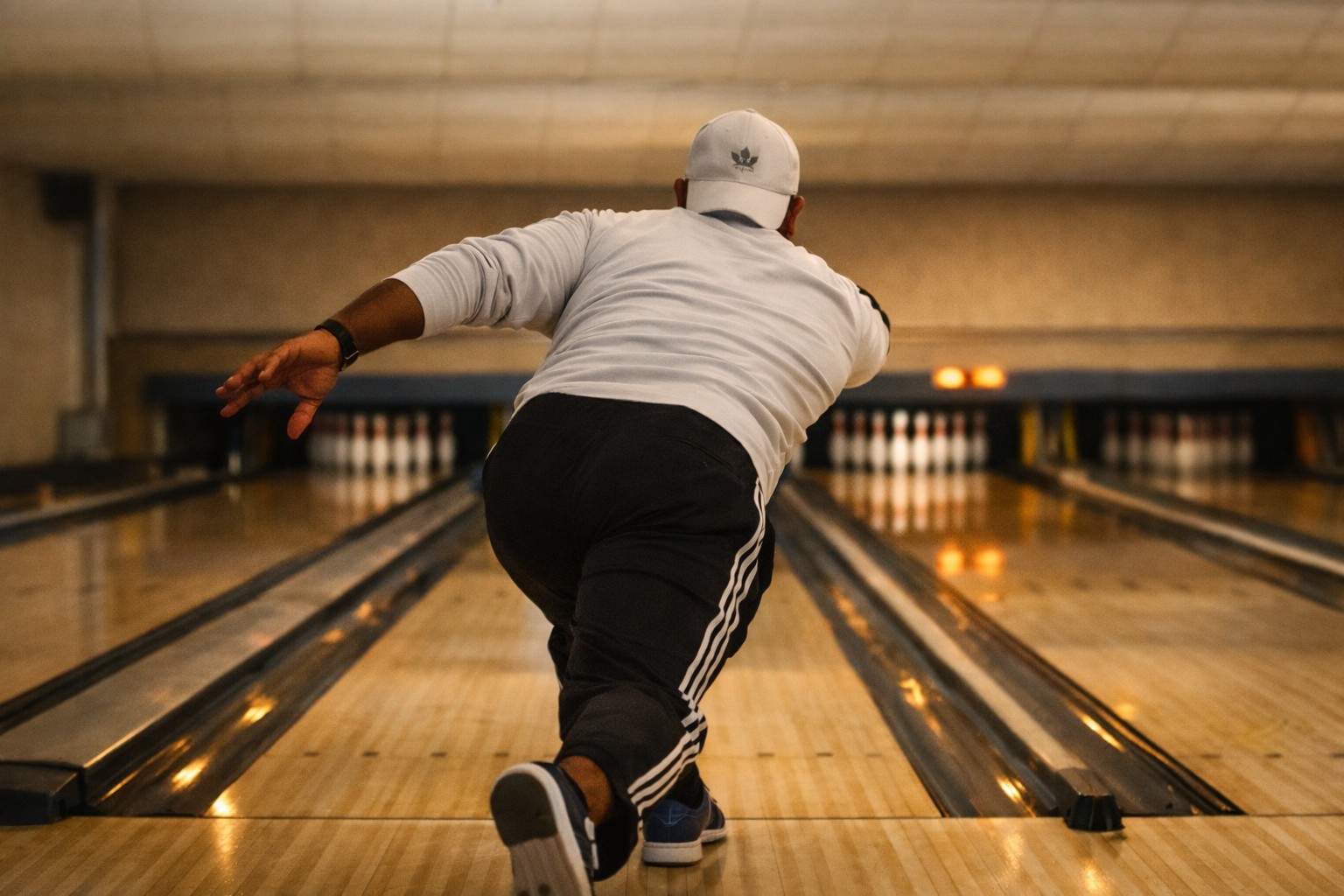
Here’s something I’ve learned after years of coaching recreational bowlers: the difference between a 120 average and a 160 average almost never comes down to raw talent. It comes down to five specific, repeatable mistakes that show up in nearly every recreational bowler’s game — often all five in the same session.
The good news is that none of them require a new ball, a new approach style, or years of practice to fix. Each one has a direct, concrete correction you can apply at your next practice session. And when you fix all five together, the improvements compound. Bowlers I’ve coached have added 20, 30, even 40 pins to their average by working through this list systematically over a single season.
This post is the complete guide. Each mistake links to a dedicated deep-dive post with full drills, biomechanics explanations, and practice challenges. Work through them in order — each fix builds on the one before it.
What You’ll Learn
- The 5 mistakes costing recreational bowlers the most pins per game
- Why these mistakes happen — and why they’re invisible to most bowlers
- The specific fix for each one, with estimated pin gains
- How to work through all five systematically over one season
- The one mental framework that holds every fix together under pressure
The 5 Mistakes at a Glance
| # | Mistake | What It Costs You | Estimated Fix |
|---|---|---|---|
| 1 | Rushing your approach | Timing breakdown, forced release, inconsistent entry angle | +4 to +6 pins/game |
| 2 | Wrong starting position | Systematic misses left or right, no adjustment reference | +3 to +5 pins/game |
| 3 | Death-gripping the ball | Killed rotation, skidding ball, weak pin carry | +4 to +7 pins/game |
| 4 | Aiming at the pins | No precision targeting, can’t self-correct, spare shooting breakdown | +5 to +8 pins/game |
| 5 | No pre-shot routine | Practice performance doesn’t transfer to league play | +3 to +5 pins/game |
Add those up and you’re looking at 19 to 31 pins per game — all from fixing mechanical and mental habits, not from buying new equipment or rebuilding your game from scratch.
Mistake #1: Rushing Your Approach
This is the most common mistake I see from the moment a new coaching student steps onto the approach — and it’s almost always invisible to the bowler making it. A rushed approach feels normal because it’s been normal for years. The body has adapted, compensated, and made it work just well enough that the root cause never gets identified.
Here’s what’s actually happening: your approach is a timing mechanism. Your feet and your ball arm need to arrive at the foul line together, in sync, every single delivery. When you rush — even slightly — your feet arrive before your swing does, and your body compensates by pushing or forcing the ball instead of swinging it freely. That compensation produces flat shots, inconsistent entry angles, and the splits that seem to come out of nowhere on shots that “felt perfect.”
The culprit is almost always the first step. Your first step sets the tempo for everything that follows. Rush it and you’ve already broken the timing chain before the ball has moved an inch.
“Slow is smooth. Smooth is consistent. Consistent is strikes.”
The Fix in One Sentence
Consciously slow your first step to 80% of your normal pace — let the rest of the approach build naturally from that controlled tempo.
The Drill
The Slow-Motion Drill: spend the first 5 minutes of every practice session walking through your full approach at 50% speed — no ball, just footwork and arm swing in sync. Once the rhythm feels smooth at half speed, pick up the ball and repeat. Gradually return to full pace carrying that tempo.
Most bowlers feel the difference in the first three reps.
📖 Full breakdown: How to Stop Rushing Your Bowling Approach — Fix #1 — includes the complete Slow-Motion Drill, how to diagnose rushing from video, and why this fix prevents splits.
Mistake #2: Not Knowing Where You’re Standing
Ask a recreational bowler which boards their feet are on at their starting position. Nine times out of ten they’ll say something like “around the middle” or “where I always stand.” That vagueness is costing them pins every single game.
Your starting position is the foundation of every shot. It determines your approach angle, your swing path, and ultimately your entry angle into the pocket. Stand in the wrong place — even slightly — and no amount of release adjustment, ball speed, or targeting will fully compensate. You’re working against the geometry of the lane from the very first step.
Every bowling lane has a built-in targeting system: seven dots at the foul line and seven arrows 15 feet down the lane. Most recreational bowlers have been bowling on top of this system for years without using it. When you know your exact starting position in board numbers, and you know which arrow you’re targeting, you have a data-driven system for self-correction that works every single game — regardless of lane conditions.
The Fix in One Sentence
Establish your exact starting position in board numbers — slide foot on board X, starting foot on board Y — and write it down.
The Drill
The Board-By-Board Adjustment Drill: bowl three shots from your baseline, then move 1 board right and bowl three more, then 1 board left. You’ll discover that a 1-board foot adjustment produces roughly a 3-board difference at the pins — and you’ll have a tangible adjustment system for the rest of your bowling life.
📖 Full breakdown: Fix Your Bowling Starting Position — Fix #2 — includes how the dots and arrows work as a targeting GPS, the step-by-step process for finding your exact boards, and why writing it down is one of the smartest things a league bowler can do.
Mistake #3: Death-Gripping the Ball
I can often diagnose this one from across the bowling center before I’ve watched a full approach. I hear it first — a flat, dull thud when the ball hits the pins instead of the crisp crack of a properly rolled ball. Then I see it in the ball track: narrow, close to the thumb hole, no rotation. Then I watch the spare leaves: corner pins that should have converted, splits from shots that looked fine from the approach.
Grip tension is insidious because it’s invisible to the bowler experiencing it. You can’t feel yourself squeezing too hard — it just feels like holding the ball. But what it’s doing mechanically is contracting your forearm, stiffening your arm, and converting what should be a free pendulum swing into a muscled push. The ball leaves your hand with little to no rotation, skids through the oil pattern instead of rolling through it, and arrives at the pins with a fraction of the energy and angle a properly released ball would have.
The fix is the “sleeping bird” image: hold the ball firmly enough that it won’t fall, but gently enough that you wouldn’t hurt it. On a 1–10 tension scale, you’re aiming for a 4 or 5 — not the 7 or 8 most recreational bowlers use under pressure.
The Fix in One Sentence
Rate your grip tension on a 1–10 scale before every delivery and consciously bring it to a 4 or 5 before you start your approach.
The Drill
The Towel Drill: drape a small hand towel over your bowling hand and walk through your full approach without the ball. If your swing is relaxed and free, the towel flows smoothly with your arm. If you’re tense, the towel flops and resists. Ten reps of this resets your muscle memory before you pick the ball back up.
📖 Full breakdown: Death Grip in Bowling: How Grip Tension Is Killing Your Release — Fix #3 — includes the sound test and ball track diagnosis, how to check your thumb fit, and how to hold your grip together under league pressure.
Mistake #4: Aiming at the Pins
This one surprises bowlers every time I bring it up. “Of course I aim at the pins — they’re the target.” I understand the instinct completely. But here’s the problem: the pins are 60 feet away. No human eye can track a rolling ball with meaningful precision at 60 feet. No brain can make reliable real-time adjustments based on where a ball is heading at that distance. Aiming at the pins is, functionally, not aiming at all.
Think of it like a golfer 400 yards from the hole. No golfer stands on the tee and aims at the cup. They pick an intermediate target — a patch of fairway, a tree in the distance — that sits on their intended line, and they aim there. The ball goes where they aimed. The hole takes care of itself.
Bowling has seven intermediate targets built right into every lane: the arrows, or rangefinders, positioned approximately 15 feet past the foul line. At 15 feet, your eye can track the ball with real precision. You can see whether you hit your arrow or missed it, and by how much. That data lets you make systematic adjustments instead of guessing.
The rule is simple: when you miss your target, you move your feet — not your eyes. Your arrow stays fixed. Your starting position shifts to bring the ball back on line. This one change converts spare shooting from guesswork into a repeatable system.
The Fix in One Sentence
Pick a specific arrow, commit to it for the entire game, and adjust your foot position — never your target — when you miss.
The Drill
The One-Arrow Focus Drill: for one complete practice session, evaluate every shot solely on whether you hit your arrow — ignore the pins entirely. Track your arrow hit percentage. Most recreational bowlers discover they’re hitting their arrow only 40–60% of the time, even when they thought they were aiming at it. Getting that number to 70–80% transforms your pin carry.
📖 Full breakdown: How to Aim in Bowling: Stop Aiming at the Pins — Fix #4 — includes the full arrow position table, how to use targeting for every spare leave, and why bowlers who aim at arrows always outperform those who aim at pins.
Mistake #5: No Pre-Shot Routine
This is the fix that makes every other fix stick — which is exactly why it’s last.
Here’s a pattern I see constantly with coaching students: they work through the first four fixes, apply them in practice, and bowl noticeably better. Then league night comes. The approach rushes. The grip tightens. The eyes drift to the pins. By frame seven, everything they worked on has evaporated.
This isn’t weakness. It’s the absence of a system that resets you to your best mechanics on every single delivery, regardless of score, regardless of pressure, regardless of who’s watching. That system is your pre-shot routine.
A pre-shot routine is a fixed sequence of 4–5 actions you execute identically before every delivery. It’s the container that holds all four previous fixes together. Here’s the framework I give every coaching student:
- Pick up the ball — same grip every time. This is your grip tension check: rate yourself on the 1–10 scale before your thumb goes in.
- Find your starting position — exact boards every time. Not approximately. Exactly.
- Lock eyes on your arrow — not the pins. Let your focus settle on your target before you move.
- One deep breath — exhale the last frame. Inhale through the nose, exhale through the mouth. This physically reduces your stress response and relaxes your grip automatically.
- Step. Every time. No exceptions.
Notice what just happened: step 1 addresses Fix #3 (grip tension), step 2 addresses Fix #2 (starting position), step 3 addresses Fix #4 (targeting), and step 4 addresses Fix #1 (rushing). The routine doesn’t add complexity — it organizes everything you’ve already learned into an automatic sequence.
The Fix in One Sentence
Build a 4-step routine, write it on a card, and complete it on every single delivery for three full practice sessions until it’s automatic.
📖 Full breakdown: Bowling Pre-Shot Routine: The 4-Step System That Makes Everything Else Work — Fix #5 — includes the complete Routine Lock-In Challenge, how to hold your routine together under league pressure, and why the pre-shot routine is the single highest-leverage habit a recreational bowler can build.
How to Work Through All 5 Fixes
Don’t try to fix all five at once. That’s how habits don’t form. Here’s the system that works:
- Pick Fix #1. Read the full post. Take the drill to the lanes. Apply it for a minimum of three full practice sessions before evaluating.
- Move to Fix #2. Same process. Three sessions minimum.
- Continue through Fix #3 and Fix #4 at the same pace.
- Build your pre-shot routine (Fix #5) last — so it contains all four previous fixes as its checkpoints.
- Run the full routine in a real league game. Note which fixes hold and which break down under pressure — those are your next practice priorities.
At three sessions per fix, the full sequence takes approximately five to six weeks of regular practice. Most bowlers see meaningful score improvement by week three — when fixes #1 and #2 are working together. The gains compound from there.
A Note on Patience
Every fix in this list involves breaking a habit your muscle memory has been reinforcing for years — possibly decades. Habits don’t change overnight, and they always feel awkward before they feel natural. That awkward phase is not failure. It’s the gap between old pattern and new one, and it always closes with consistent repetition.
Give each fix the three sessions it needs. Trust the process. The pins will tell you when it’s working.
Frequently Asked Questions
Do I need new equipment to fix these mistakes?
No. Every fix in this list is mechanical or mental — none of them require a different ball, new shoes, or any equipment change. That said, Fix #3 (death grip) sometimes reveals a thumb fit issue where the equipment is contributing to the habit. If that’s the case, a pro shop fitting is worth the investment. But start with the technique fix first.
I’ve been bowling for 20 years. Will these fixes actually help me?
Yes — often more dramatically than for newer bowlers, because long-term habits are deeply ingrained and the gap between current performance and potential is larger. The most striking improvements I’ve seen in coaching have come from experienced recreational bowlers who had been making the same two or three mistakes for years without knowing it.
Which mistake is most common?
In my coaching experience, Fix #4 (aiming at the pins instead of the arrows) is the most universally present — it’s the default for almost every bowler who hasn’t been formally coached. Fix #1 (rushing) is a close second. Fix #5 (no routine) is universal but only becomes apparent under game pressure.
Can I work on more than one fix at a time?
You can, but I’d caution against it for most bowlers. Habit formation requires focused attention, and splitting that attention between two mechanical changes typically means neither one fully ingrains. The exception is Fix #4 and Fix #2 — targeting and starting position are closely linked and some bowlers find it natural to work on them together.
These five fixes are the foundation of everything I teach in coaching sessions. Whether you’re working through them independently or you’d like personalized feedback on which ones are showing up in your specific game, the path to a better average starts here.
Ready to work through these with personalized feedback?
Mr. Wendell offers one-on-one coaching, group sessions, and online video analysis — so every fix gets applied to your specific game, not a generic template. One session identifies which of these five mistakes is costing you the most pins.
Leave a Reply